
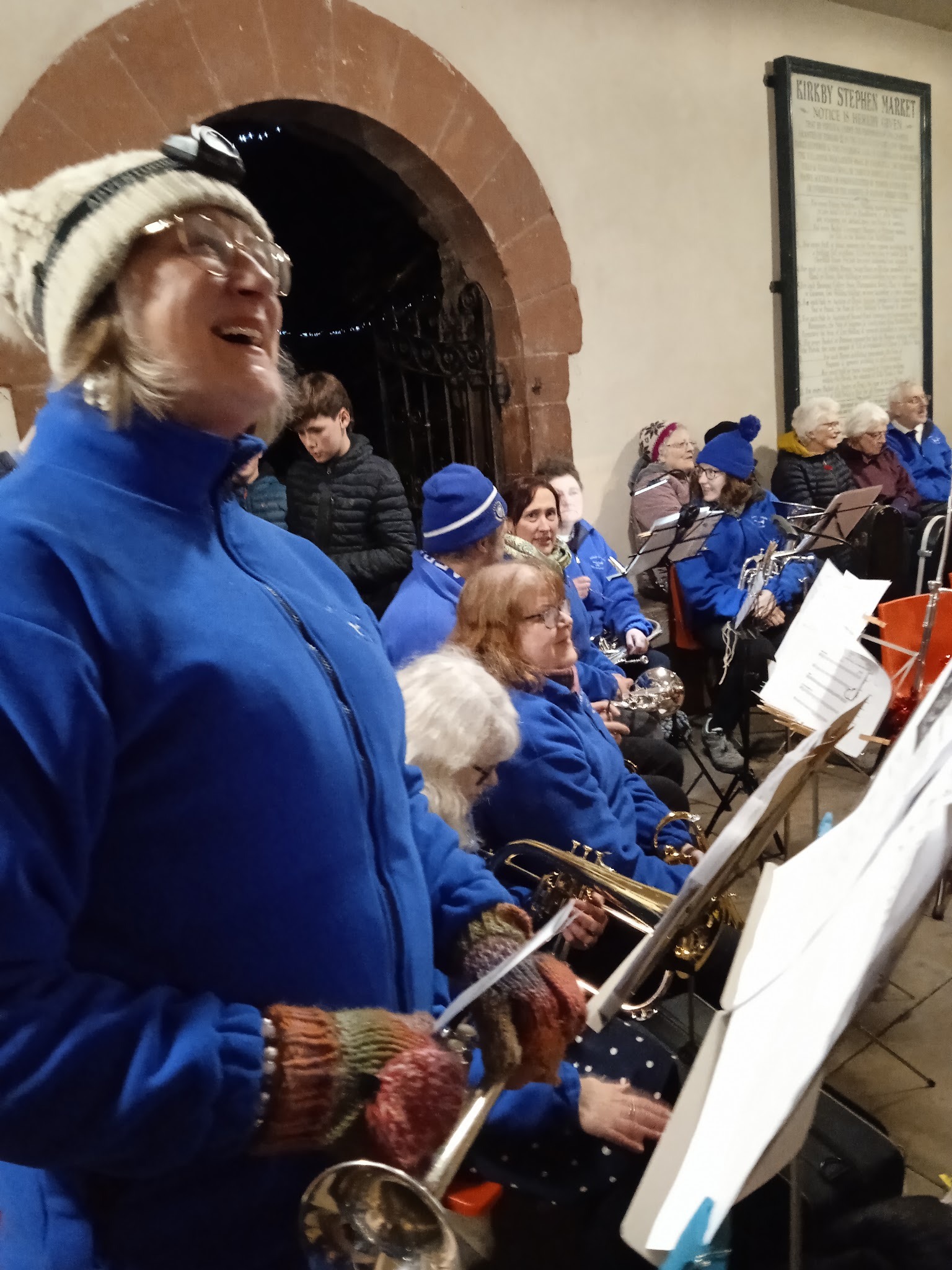
How one rural brass band became the inspiration for School of Brass
When Kirkby Stephen Silver Band emerged from the pandemic with just seven regular players, we set out to answer a simple question: could a structured beginner programme help secure the band's future? Four years later, the answer is yes.
"There wasn't a blueprint—we simply believed people would come if we removed enough barriers."
The journey at a glance
| September 2022 | School of Brass pilot launched: |
| 6 young learners recruited | |
| 8 adult beginners joined the first cohort | |
| December 2022 | First Christmas performance together |
| June 2026 | KSSB Training Band established |
| Main band rebuilt to almost full membership |
Can a brass band secure its future by teaching beginners?
We know that across the country, community brass bands are facing similar challenges: player numbers are falling, volunteers are stretched, and everyone agrees recruitment is important but few have the time or capacity to make it happen.
Four years ago, Kirkby Stephen Silver Band was in exactly that position.
After leaving Leicester to be closer to my parents in Cumbria, I joined Kirkby Stephen Silver Band. I'd imagined I would be less involved with leading music groups. I was mistaken.
Almost simultaneously with my arrival, Covid hit and, for two years, life was in limbo for all of us.
Like many bands, KSSB was badly affected. Formed in 1857, the band has expanded and contracted many times over the years, but post-Covid player numbers were down to just eleven, with only seven regularly appearing for rehearsals.
We needed to do something—but what? The members were already giving everything they could and simply didn't have the time to organise recruitment.
Trying something different
I asked whether Drum and Brass could help by accessing project funding to start a training band.
We worked out a simple partnership. Kirkby Stephen Silver Band would provide the band room and instruments, while Drum and Brass would secure funding, recruit learners and deliver the teaching through grant funding and subscriptions.
To my knowledge, this had never been done before. There was no playbook for how it would work.
We started by recruiting six young learners from the local primary school, who began learning on Thursday evenings.
Then, in September 2022, I was thrilled when our first Friday rehearsal attracted eight brand new adult learners. They had responded to Facebook adverts and to the persuasive powers of legendary local café owner Maz, who wanted to have a go himself and encouraged others to join him.
These new players were incredibly committed and made staggering progress. Both groups joined in the Christmas carols that first year, and for a while it looked as though we had solved every problem faced by community brass bands.
What really happened
Of course, the post-Covid period was unusual.
Gradually, all but one of our young players drifted away as life returned to normal. Looking back, retaining one in six wasn't actually a bad outcome, we now know that's a challenge shared by many youth music projects.
The adult programme, however, continued to grow.
Each September we welcomed a new beginner cohort, and the enthusiasm generated by those learners encouraged experienced players to return to the main band.
Before long, some of those Friday night beginners were joining the senior band themselves. Any band member will recognise what a huge leap that is; from training band music to full brass band repertoire, but they rose to the challenge.
Today, Kirkby Stephen Silver Band enjoys an almost full band membership.
Even better, Drum and Brass has now handed the Friday group over completely. It has become the official Kirkby Stephen Silver Band Training Band with its own Musical Director. Many of those original beginners still meet each week, continuing to improve their playing in a friendly, supportive environment.
That's exactly how it should be. Our role was never to run the training band forever; it was to help create something sustainable.
Our expertise and capacity is still needed, however, to work with the new beginners who join each September following local flyer campaigns and social media recruitment.
What did we learn?
The experience taught us some valuable lessons.
There is a real appetite for learning to play brass amongst people who may never have considered it before. Clear messaging, a welcoming atmosphere and a simple invitation can persuade complete beginners to give it a try.
Young people remain harder to recruit and retain, but those who do pick up a brass instrument thrive socially, musically and often in school too. There is still much work to do at every level; from grassroots community organisations to national policy, to create stronger pathways for young musicians.
Perhaps most importantly, we learned that community brass bands have enormous potential to secure both their present and their future by offering high-quality musical education alongside a valuable community service.
The challenge is that many bands simply don't have the time, resources or confidence to build those programmes on their own.
Why we created School of Brass
Everything we learned through our work with Kirkby Stephen Silver Band became the foundation for School of Brass.
Rather than expecting bands to start from scratch, School of Brass provides practical support including funding advice, recruitment materials, teaching resources, setup templates and structured learning programmes that help transform a band into a vibrant learning hub for its community.
Every community is different, but the principles remain the same.
If one small rural brass band could grow from seven regular players to an almost full band while establishing its own thriving training band, imagine what could happen elsewhere.
School of Brass exists to help more bands do exactly that.